
Search
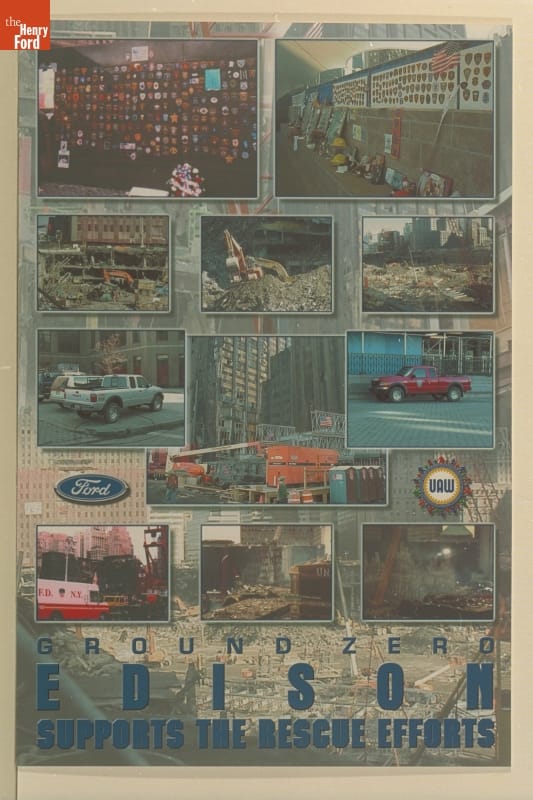
- Poster, "Ground Zero-- Edison Supports the Rescue Efforts," Ford Motor Company, 2001 - Ford Motor Company loaned 15 pickups to the New York-New Jersey Port Authority following the September 11, 2001, attack on the World Trade Center. The attack destroyed many of the Port Authority's vehicles. Ford's pickups, built at the company's plant in Edison, New Jersey, were pre-production prototypes of the Ranger FX4 -- a heavy-duty, four-wheel-drive truck with special off-road equipment.
- September 11, 2001
- Collections - Artifact
Poster, "Ground Zero-- Edison Supports the Rescue Efforts," Ford Motor Company, 2001
Ford Motor Company loaned 15 pickups to the New York-New Jersey Port Authority following the September 11, 2001, attack on the World Trade Center. The attack destroyed many of the Port Authority's vehicles. Ford's pickups, built at the company's plant in Edison, New Jersey, were pre-production prototypes of the Ranger FX4 -- a heavy-duty, four-wheel-drive truck with special off-road equipment.
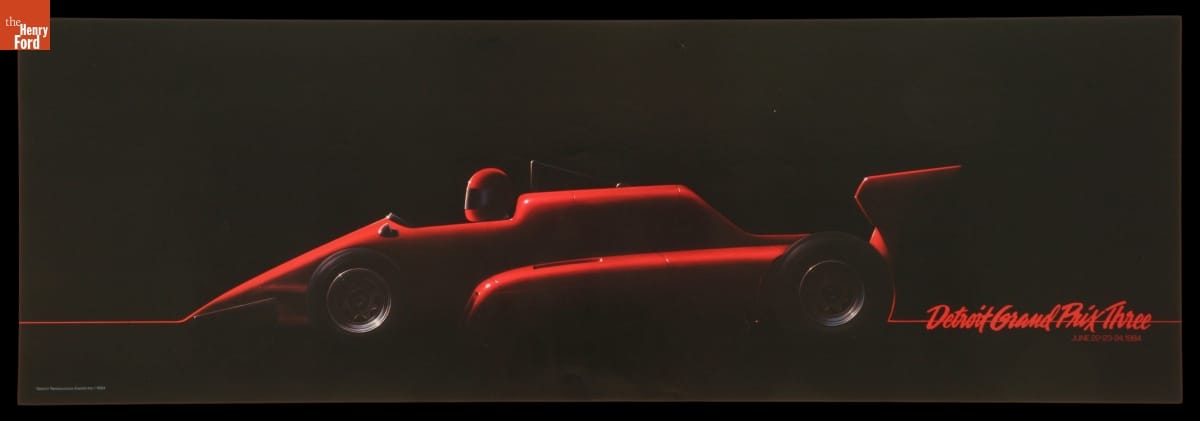
- Racing Poster, "Detroit Grand Prix Three," 1984 - From 1982 to 1988, the annual Detroit Grand Prix was a Formula One event with drivers competing on a challenging street circuit through downtown. Each year, an original commemorative poster captured the excitement of the race. Brazilian driver Nelson Piquet won the 1984 contest for Britain's Brabham team. The race shifted to the CART Indy car series in 1989.
- 22 June 1984 - 24 June 1984
- Collections - Artifact
Racing Poster, "Detroit Grand Prix Three," 1984
From 1982 to 1988, the annual Detroit Grand Prix was a Formula One event with drivers competing on a challenging street circuit through downtown. Each year, an original commemorative poster captured the excitement of the race. Brazilian driver Nelson Piquet won the 1984 contest for Britain's Brabham team. The race shifted to the CART Indy car series in 1989.
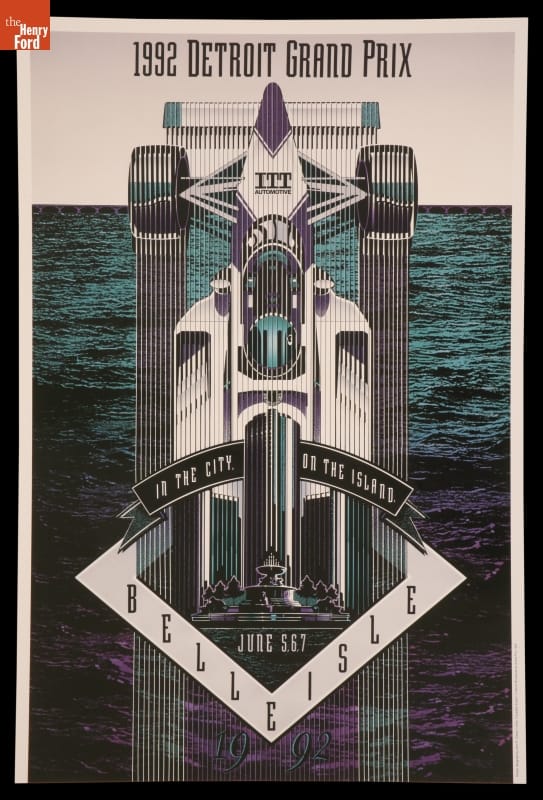
- Racing Poster, "1992 Detroit Grand Prix" - Detroit hosted its first Grand Prix in 1982. The annual event transitioned from Formula One to the CART Indy car series in 1989. While the first ten races used a street circuit downtown, in 1992 the competition moved to nearby Belle Isle in search of better track conditions. Driver Bobby Rahal earned the win that year for Rahal-Hogan Racing.
- 05 June 1992 - 07 June 1992
- Collections - Artifact
Racing Poster, "1992 Detroit Grand Prix"
Detroit hosted its first Grand Prix in 1982. The annual event transitioned from Formula One to the CART Indy car series in 1989. While the first ten races used a street circuit downtown, in 1992 the competition moved to nearby Belle Isle in search of better track conditions. Driver Bobby Rahal earned the win that year for Rahal-Hogan Racing.
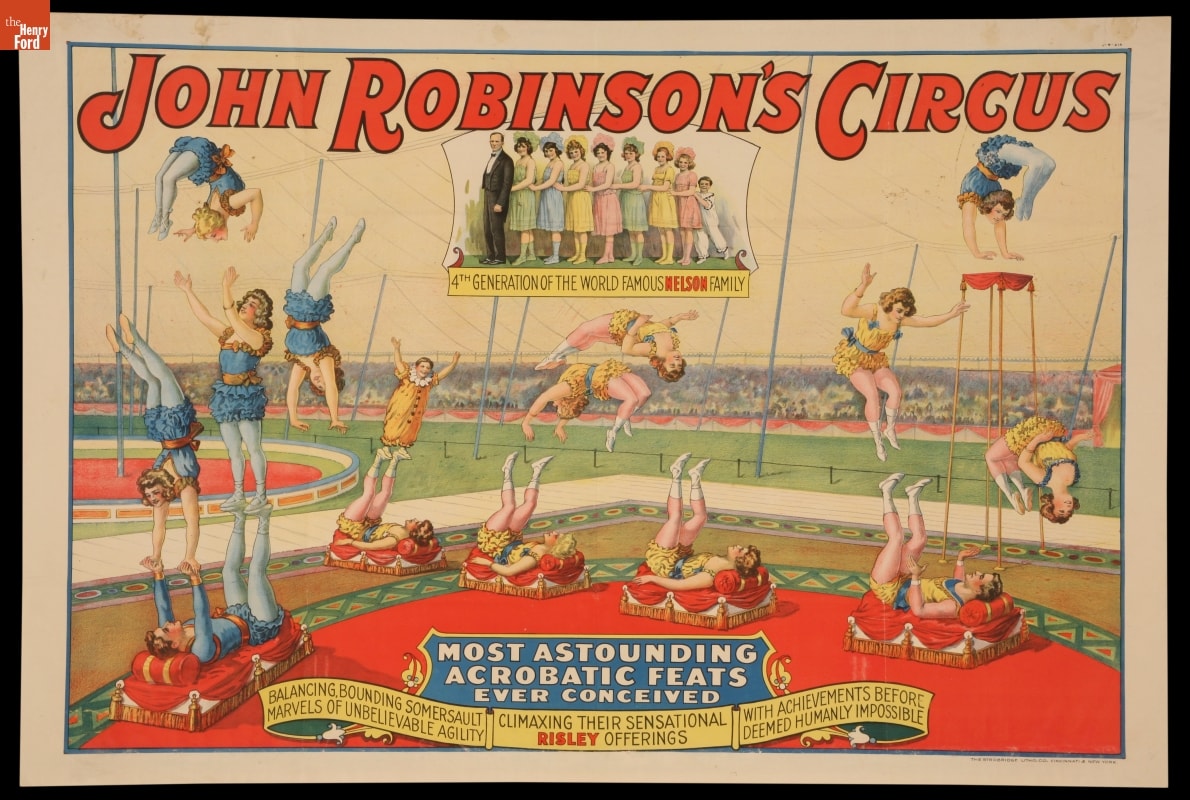
- Circus Poster, "John Robinson's Circus," circa 1925 - In the late nineteenth century, printers developed a lithograph method that produced brightly colored posters. In advance of a circus coming to town, general agents glued these eye-catching generic posters to building walls, fences, and in window displays. To announce when and where the performances would happen, local printers sometimes provided letterpress paper date strips to paste onto the posters' lower margin.
- circa 1925
- Collections - Artifact
Circus Poster, "John Robinson's Circus," circa 1925
In the late nineteenth century, printers developed a lithograph method that produced brightly colored posters. In advance of a circus coming to town, general agents glued these eye-catching generic posters to building walls, fences, and in window displays. To announce when and where the performances would happen, local printers sometimes provided letterpress paper date strips to paste onto the posters' lower margin.
- Advertising Poster, "Old Fashion Molasses," circa 1900 - This turn-of-the-twentieth-century advertisement was used to sell Old Fashion Molasses. This and similar ads with depictions of African American also reflect the racial prejudices of the time. To white consumers this seemingly innocuous image of a smiling African-American woman idealized nonexistent times when whites believed they ruled benevolently and blacks "knew their place." The added stereotypical language also supported this racial view.

- circa 1900
- Collections - Artifact
Advertising Poster, "Old Fashion Molasses," circa 1900
This turn-of-the-twentieth-century advertisement was used to sell Old Fashion Molasses. This and similar ads with depictions of African American also reflect the racial prejudices of the time. To white consumers this seemingly innocuous image of a smiling African-American woman idealized nonexistent times when whites believed they ruled benevolently and blacks "knew their place." The added stereotypical language also supported this racial view.
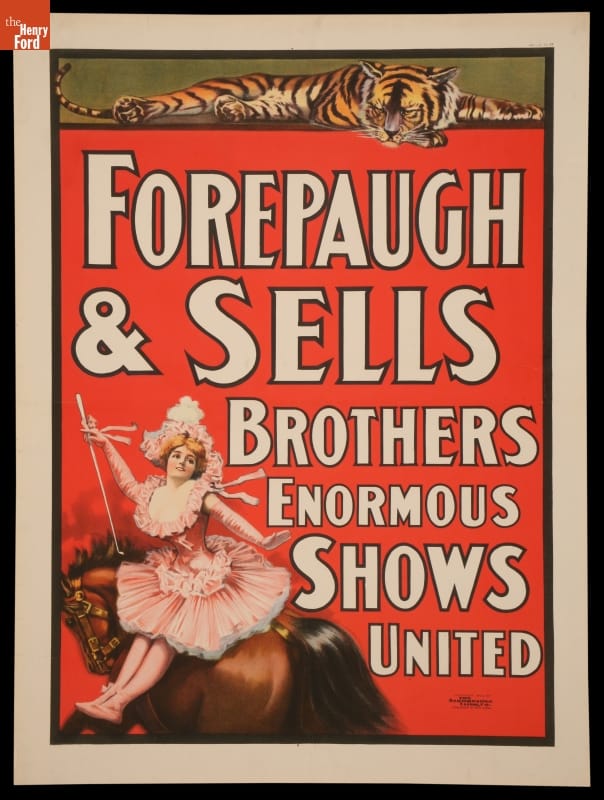
- Circus Poster, "Forepaugh & Sells Brothers Circus Enormous Shows United," 1902 - In the late nineteenth century, printers developed a lithograph method that produced brightly colored posters. In advance of a circus coming to town, general agents glued these eye-catching generic posters to building walls, fences, and in window displays. To announce when and where the performances would happen, local printers sometimes provided letterpress paper date strips to paste onto the posters' lower margin.
- 1902
- Collections - Artifact
Circus Poster, "Forepaugh & Sells Brothers Circus Enormous Shows United," 1902
In the late nineteenth century, printers developed a lithograph method that produced brightly colored posters. In advance of a circus coming to town, general agents glued these eye-catching generic posters to building walls, fences, and in window displays. To announce when and where the performances would happen, local printers sometimes provided letterpress paper date strips to paste onto the posters' lower margin.
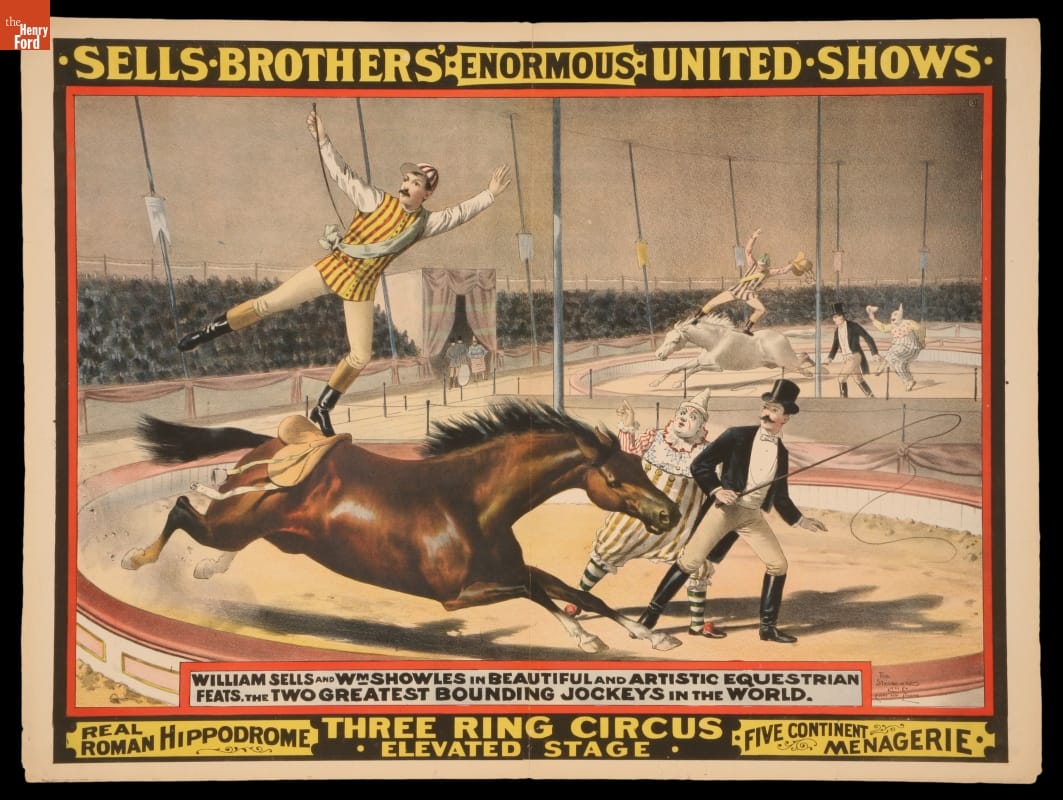
- Circus Poster, Sells Brothers Enormous United Shows, Equestrians in Three Ring Circus, circa 1890 - In the late nineteenth century, printers developed a lithograph method that produced brightly colored posters. In advance of a circus coming to town, general agents glued these eye-catching generic posters to building walls, fences, and in window displays. To announce when and where the performances would happen, local printers sometimes provided letterpress paper date strips to paste onto the posters' lower margin.
- circa 1890
- Collections - Artifact
Circus Poster, Sells Brothers Enormous United Shows, Equestrians in Three Ring Circus, circa 1890
In the late nineteenth century, printers developed a lithograph method that produced brightly colored posters. In advance of a circus coming to town, general agents glued these eye-catching generic posters to building walls, fences, and in window displays. To announce when and where the performances would happen, local printers sometimes provided letterpress paper date strips to paste onto the posters' lower margin.
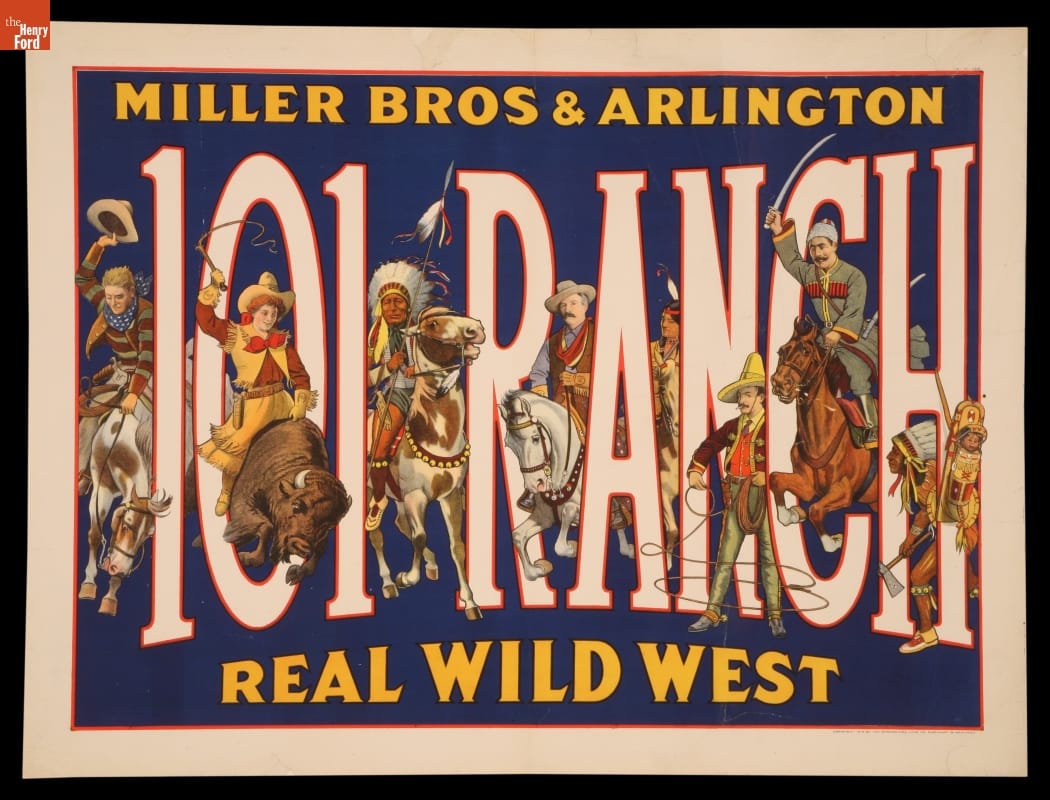
- Circus Poster, Miller Brothers & Arlington Circus, Featuring the "101 Ranch, the Real Wild West," 1913 - In the late nineteenth century, printers developed a lithograph method that produced brightly colored posters. In advance of a circus coming to town, general agents glued these eye-catching generic posters to building walls, fences, and in window displays. To announce when and where the performances would happen, local printers sometimes provided letterpress paper date strips to paste onto the posters' lower margin.
- 1913
- Collections - Artifact
Circus Poster, Miller Brothers & Arlington Circus, Featuring the "101 Ranch, the Real Wild West," 1913
In the late nineteenth century, printers developed a lithograph method that produced brightly colored posters. In advance of a circus coming to town, general agents glued these eye-catching generic posters to building walls, fences, and in window displays. To announce when and where the performances would happen, local printers sometimes provided letterpress paper date strips to paste onto the posters' lower margin.
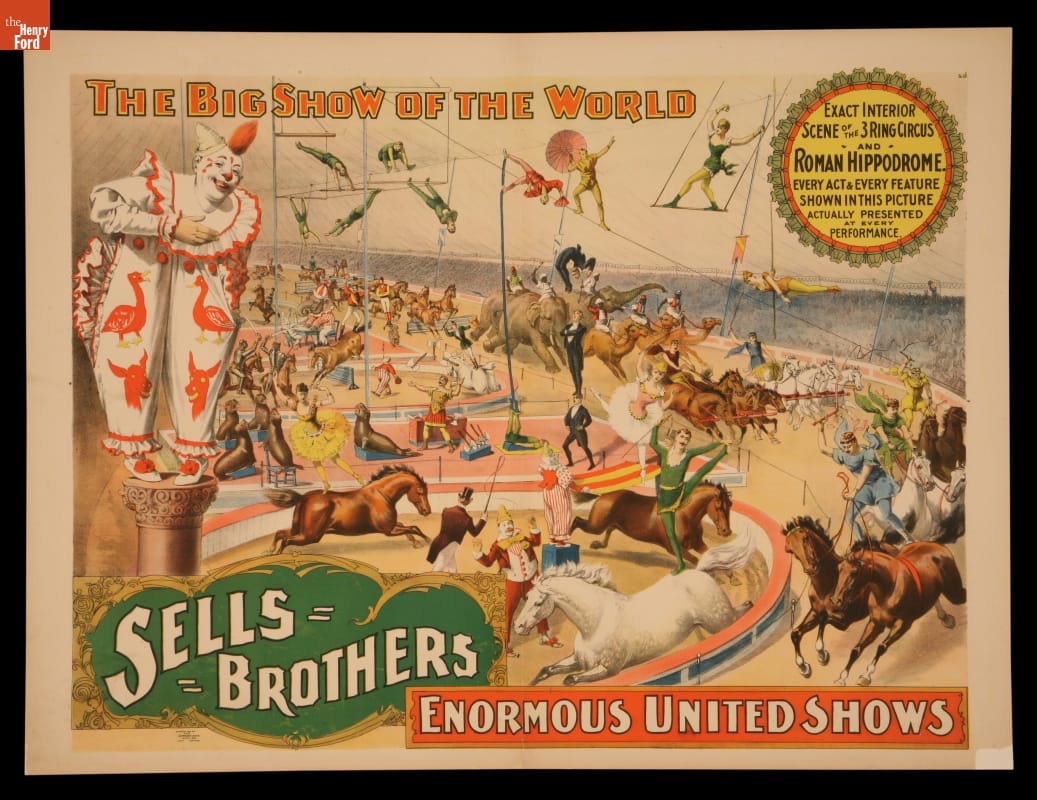
- Circus Poster, "Sells Brothers Enormous United Shows," 1893 - In the late nineteenth century, printers developed a lithograph method that produced brightly colored posters. In advance of a circus coming to town, general agents glued these eye-catching generic posters to building walls, fences, and in window displays. To announce when and where the performances would happen, local printers sometimes provided letterpress paper date strips to paste onto the posters' lower margin.
- 1893
- Collections - Artifact
Circus Poster, "Sells Brothers Enormous United Shows," 1893
In the late nineteenth century, printers developed a lithograph method that produced brightly colored posters. In advance of a circus coming to town, general agents glued these eye-catching generic posters to building walls, fences, and in window displays. To announce when and where the performances would happen, local printers sometimes provided letterpress paper date strips to paste onto the posters' lower margin.
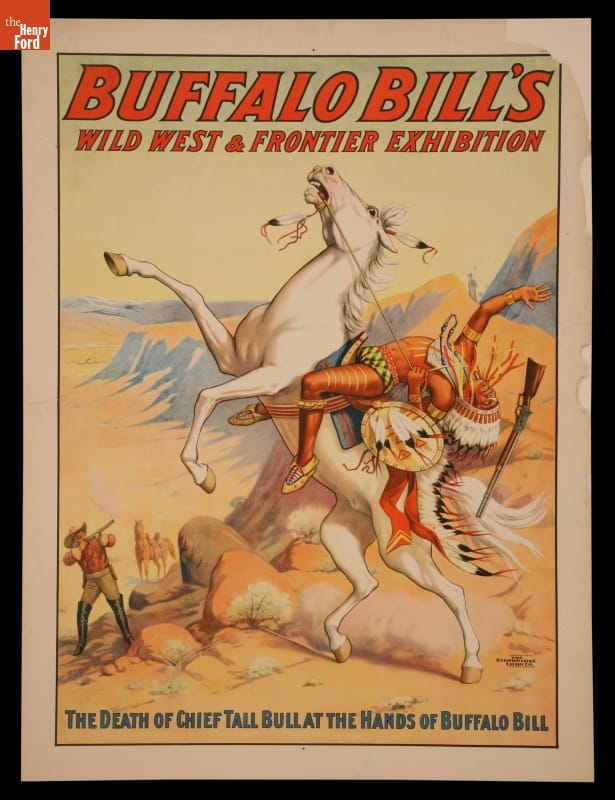
- Circus Poster, Buffalo Bill's Wild West & Frontier Exhibition, 1908 -
- 1908
- Collections - Artifact
Circus Poster, Buffalo Bill's Wild West & Frontier Exhibition, 1908